Follow the question.
Start with a real need. Investigate the data, the context and where AI can make a meaningful difference.
Coding Blocks is an AI-first company. Our dedicated labs bring AI, machine learning and data science together to explore ideas, test approaches and build useful systems.
Strong foundations. Curious minds. Working code.
experiment = Lab(curiosity=True)
experiment.learn().build().evaluate()
Our lab connects exploration with engineering. We ask useful questions, work with data and turn what we learn into something people can use.
Start with a real need. Investigate the data, the context and where AI can make a meaningful difference.
Build a baseline, try alternatives and measure what changes. Let evidence guide the next iteration.
Bring models, interfaces and infrastructure together. Think about the people who will use the system.
Explore the topics and example projects that connect AI foundations to practical applications. These examples illustrate project directions, rather than a list of completed deployments.
12 example projects across 6 lab areas.
Systems that retrieve, reason and act.
Turn a collection of documents into a searchable assistant with source-backed answers.
Build ingestion, retrieval and a cited answer interface. Evaluate unsupported answers, retrieval relevance and response time.
Explore an assistant that plans tasks and uses tools with explicit human approval.
Connect a small set of tools, log each decision and add approval steps before consequential actions. Test recovery when a tool fails.
Predictions you can test and explain.
Explore time-series models that help teams anticipate demand and plan inventory.
Create a leakage-free time split, compare against a simple baseline and report forecast uncertainty across different demand patterns.
Match people with useful content using behaviour, similarity and ranking.
Compare content-based and collaborative methods, handle new users and measure ranking quality on held-out interactions.
From raw data to a useful decision.
Translate operational data into clear dashboards, trends and questions worth exploring.
Build a reproducible data pipeline, define business metrics and make a dashboard that explains the evidence behind each insight.
Investigate cohorts, retention and the patterns behind customer churn.
Clean event data, define comparable cohorts and separate descriptive patterns from causal claims. Present the findings in an analytical report.
Help software make sense of what it sees.
Extract and validate structured information from forms, invoices and scanned documents.
Combine text extraction with field validation, surface low-confidence results for review and test across document formats.
Explore defect detection for product images and visual inspection workflows.
Label a small dataset, train a baseline and inspect false positives and missed defects before designing a review interface.
Understand the context behind the words.
Route support requests, identify intent and help teams draft useful responses.
Build an intent classifier, review ambiguous tickets and evaluate draft responses against a clear quality rubric.
Turn meeting transcripts into summaries, decisions and action items.
Create a transcript-to-summary pipeline, preserve who said what and let a reviewer confirm each proposed action item.
Make the model part of a reliable product.
Package, version and serve a model through an observable API.
Track datasets and experiments, automate validation checks and deploy a versioned endpoint with a rollback path.
Compare model behaviour, latency and cost before choosing what to ship.
Create a fixed evaluation set, compare model versions and define drift checks and review thresholds for changing inputs.
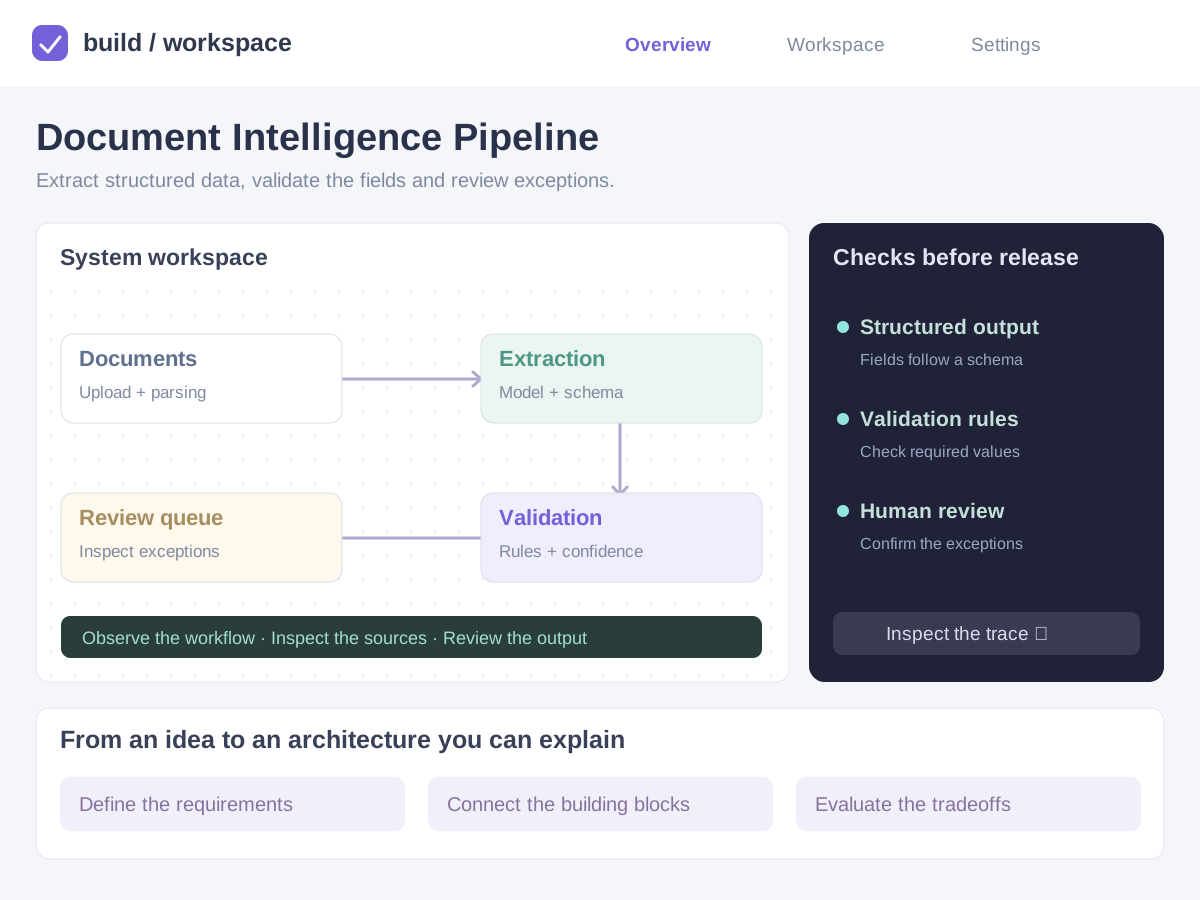
One example brings several lab disciplines together: a pipeline that reads a document, extracts its fields and helps a reviewer decide what to trust.
Ingest a document and extract text and layout.
Identify fields, structure the output and validate the values.
Highlight uncertain fields and route them for review.
A useful AI product needs more than a compelling output. The lab approach follows the whole journey, from the first question to the next iteration.
Define the problem, the user and a measurable goal.
Understand the data, its quality and its permissions.
Establish a baseline and develop a working prototype.
Test accuracy, failure cases, latency and cost.
Review behaviour, improve the system and document the learning.
Thoughtful AI, by design. Data privacy, clear evaluation and human review belong in the development process from the beginning.
Bring a question, build your foundations or explore a collaboration. There is more than one way to begin.
Explore learning paths in data science, agentic AI and applied AI engineering.
Explore AI programsHave a use case or an idea for a lab project? Start a conversation with our team.
Discuss your ideaUse the Coding Blocks tools and community resources to practise and build.
Explore resourcesIt is the space for dedicated AI, machine learning and data science work at Coding Blocks: exploring ideas, running experiments and building systems that connect models to practical problems.
The projects on this page are illustrative directions. Contact our team to ask about current lab work, demonstrations and opportunities to get involved.
Start with programming, Python, data and problem-solving foundations. Our course catalogue can help you find a learning path that fits your starting point.
Use our contact page to share the problem, the available data and what you want to explore. Our team can discuss the next step with you.
AI, ML and data science. Connected through code, experimentation and people.
Talk to the team